Before my first trip to Japan, most of my worrying was not about temples or food. It was about logistics. How do I pay for a train when my bank card does not work in the gate? Do I really have to drag a big suitcase across the country every time I change city? Will my charger even fit in the wall?
I am home now, and the short answer is that Japan is the easiest country I have ever travelled in, as long as you understand a few systems before you go. Here is what worked, what it cost, and the one thing I got genuinely wrong.
Sending my suitcase ahead, and never regretting it
This is the one I want to tell everyone about. In Japan you can send your luggage from a hotel (or the airport) to your next hotel, and it arrives the next day. It is called takkyubin, and it is completely normal there, not a luxury service.
I used it twice, and it changed the whole trip.
The first time was straight from the airport. I landed, went to the counter in arrivals, and sent my big suitcase all the way to my hotel in Kyoto. It cost 3,660 yen. I will be honest, that was more than I had estimated, and it taught me something: sending luggage from an airport across the country costs noticeably more than sending it from one city hotel to another. Worth it anyway, because it meant I took the bullet train the next day with only a small bag.
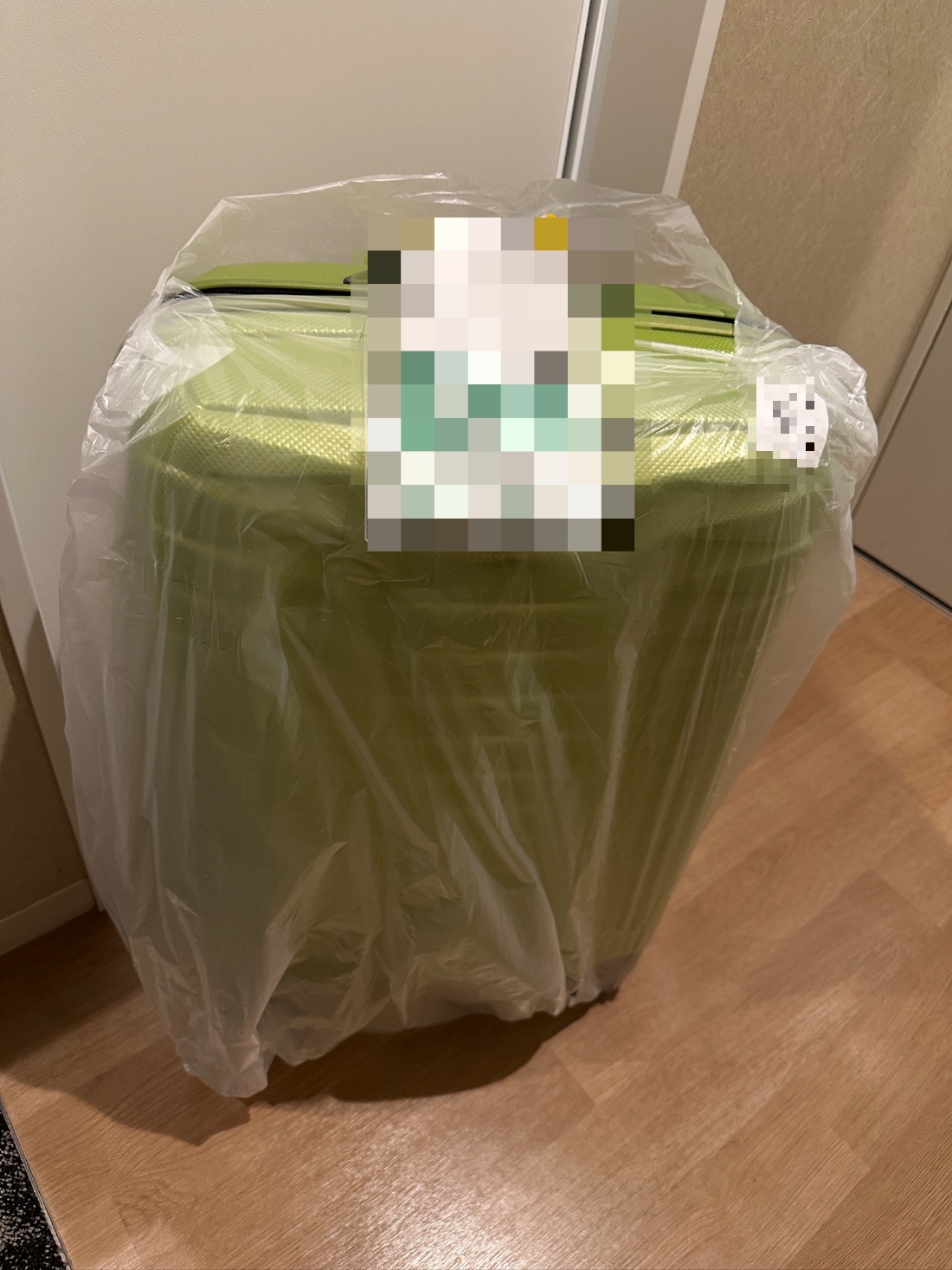
When I arrived in Kyoto, the suitcase was already at the hotel, waiting for me. Not only that, they had wrapped it in a protective plastic bag. Something about that detail said a lot about the whole country.
The second time taught me the most useful tip I brought home. I wanted to send the suitcase from my Kyoto hotel to my Tokyo hotel, so I could go to the mountains for a night with almost nothing. I walked into a delivery counter near the station and they refused. They would send it to a private home address, or to somewhere in another city, but not hotel to hotel the way I wanted. I walked out a bit deflated, thinking I would have to carry everything after all.
Then I asked my own hotel front desk. They arranged the exact same thing without blinking, for 2,680 yen. So: if a walk-in counter says no, ask your hotel. Hotels do this every single day, and they can arrange things the counters will not.
On my last day I sent the suitcase from the Tokyo hotel to the airport, which meant my final day in the city was completely hands free, no lockers, no dragging anything around. I put the bag at reception the night before, and the transport company confirmed the pickup by email around noon.
One small extra: I had an AirTag in my suitcase, and it was lovely to simply look at my phone and see the suitcase sitting in the right hotel before I even got there. If you already own one, put it in the bag.
Paying for things: the trio that covers everything
Japan looks modern, and it is, but the payment logic is its own thing. What worked for me was three things at once.
An IC card for transport and small buys. I set up a digital Suica in my phone wallet before I left, and topped it up from my card whenever it ran low. This is what you tap at train gates, in convenience stores, at vending machines and lockers. Here is the important part that surprised me: the train gates do not take normal contactless bank cards. Your Visa or Mastercard is useless at the gate. You need the IC card. One card works all over the country, so the same Suica took me through Tokyo, Kyoto and the mountains.
A credit card for the big things. Hotels, department stores, bigger restaurants and electronics shops all took my card without any drama.
Cash for everything small and old-fashioned. Small eateries, shrines, some rural places are still cash only. I had moved yen into a Revolut account before leaving, and withdrew 20,000 yen from an ATM at the airport when I landed. The fee was zero. That was one of the most satisfying small wins of the trip, and I would do exactly the same again.
One thing to know: the bullet train is not included in your IC card. You cannot just tap and get on a Shinkansen. You buy those tickets separately at the station, from a machine or a counter, and English is available. My Tokyo to Kyoto ticket was 14,370 yen, which was very close to what I had estimated.
The plug adapter, where I nearly got it wrong
This is the part where I made a mistake, and it is such an easy one to make.
Japan uses type A sockets, two flat parallel pins, and they are usually not grounded. The voltage is 100 volts. Now, phone and tablet chargers are almost always dual voltage, which means they handle both, so the voltage is not the problem. The only problem is the shape of the plug.
I owned a “universal” travel adapter and assumed it would cover me. It did not. It needed a grounded socket, and it did not have the flat type A pins at all. If I had discovered that in a hotel room in Kyoto at midnight, with a phone at four percent, that would have been a miserable evening.
What saved me was borrowing one from a friend who had been to Japan. And honestly, that is my real advice: borrow before you buy. A Japan or US adapter is the classic thing you use for one trip and then find in a drawer five years later. Someone you know has one.
The one I borrowed had a useful extra: two USB ports built into it. That mattered more than I expected, because business hotel rooms in Japan are small and sometimes have very few sockets. My setup every night was one wall socket, the adapter in it, my tablet charger in its plug, and my phone and power bank on the two USB ports. Everything charged, one socket used.
While I am here, a small related decision that turned out well: I left the electric toothbrush at home and brought a normal manual one. Nothing to charge, no voltage to check, no competing for the socket. Over nine days I did not miss it once.
What I should have left at home
Some packing lessons only arrive when you are standing in the room.
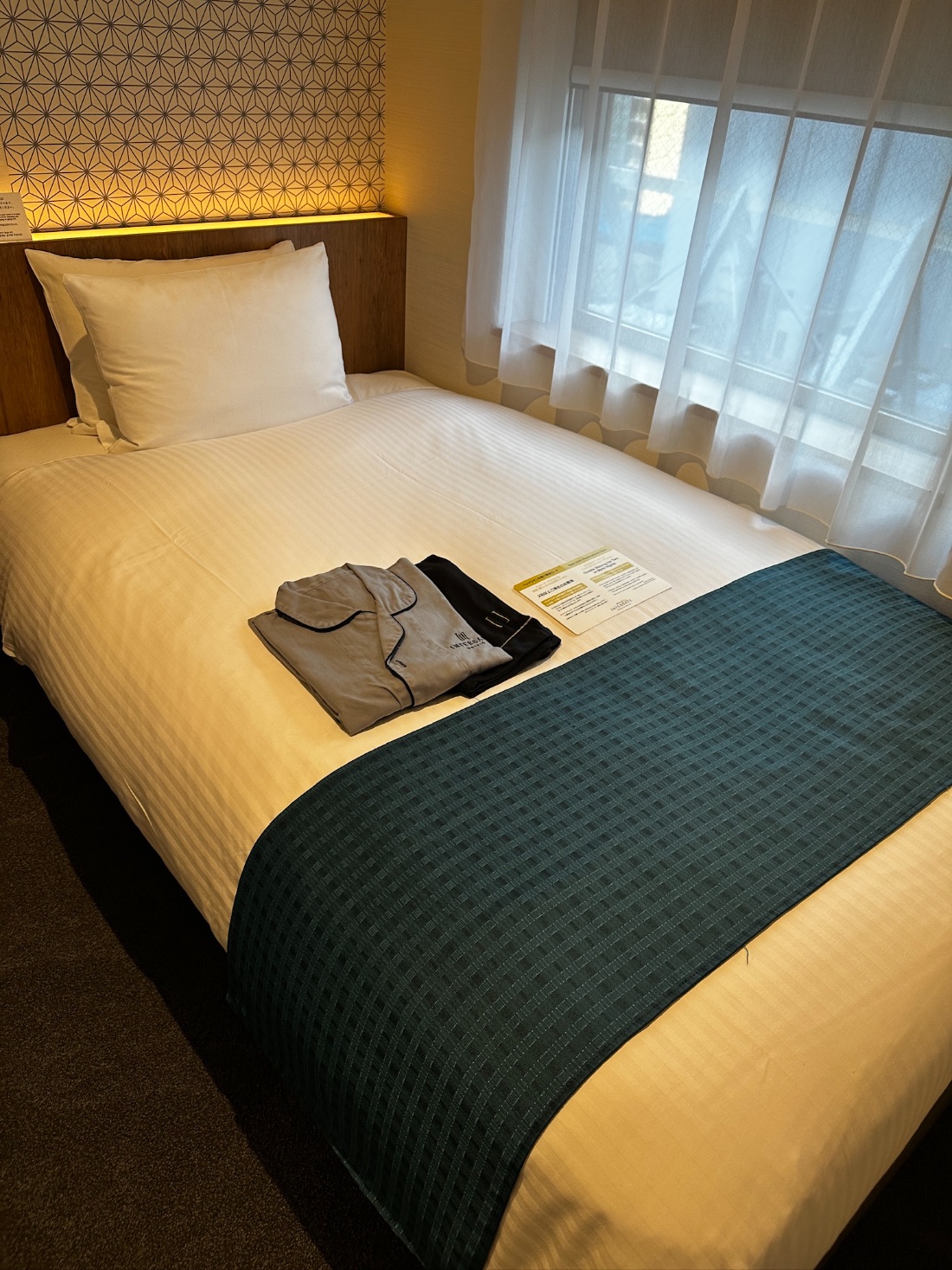
Sleepwear: unnecessary. Every hotel provided it, and so did the traditional inn. That is real space in a suitcase.
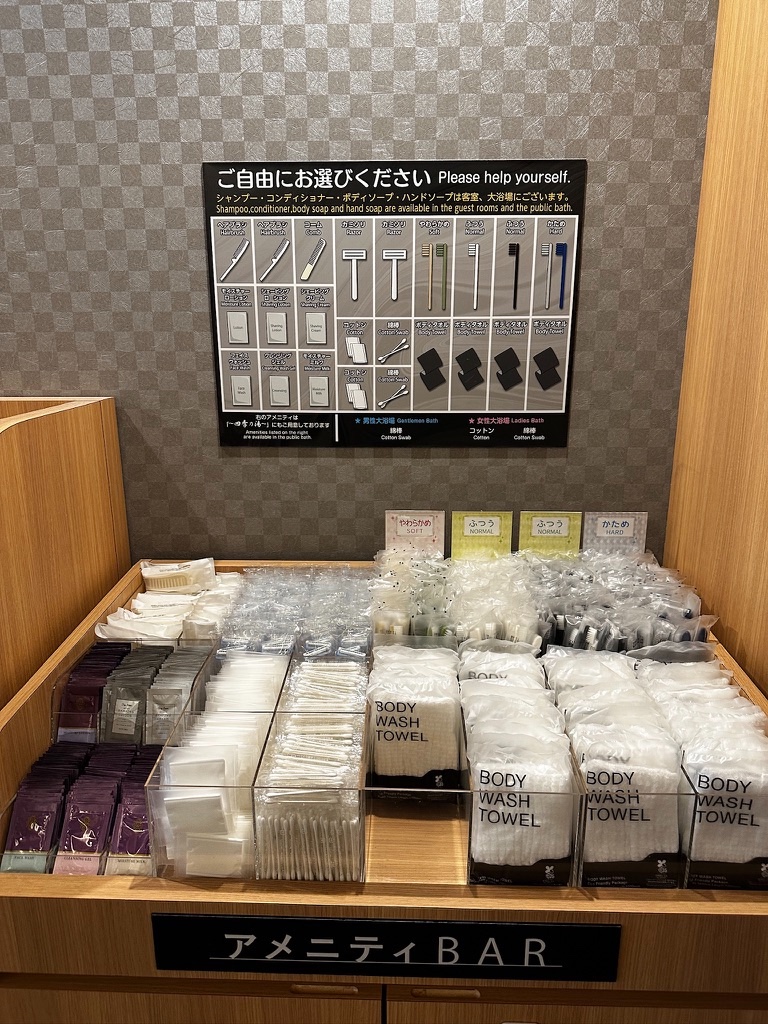
Toiletries: also unnecessary. Shampoo, conditioner and body wash were provided everywhere, and they were good. Several hotels also had an amenity bar in the lobby where you simply take what you need, with a choice of toothbrush types, cotton pads, hair ties and so on. I only really needed my own deodorant, which is genuinely hard to find in the style I am used to, and my own medication.
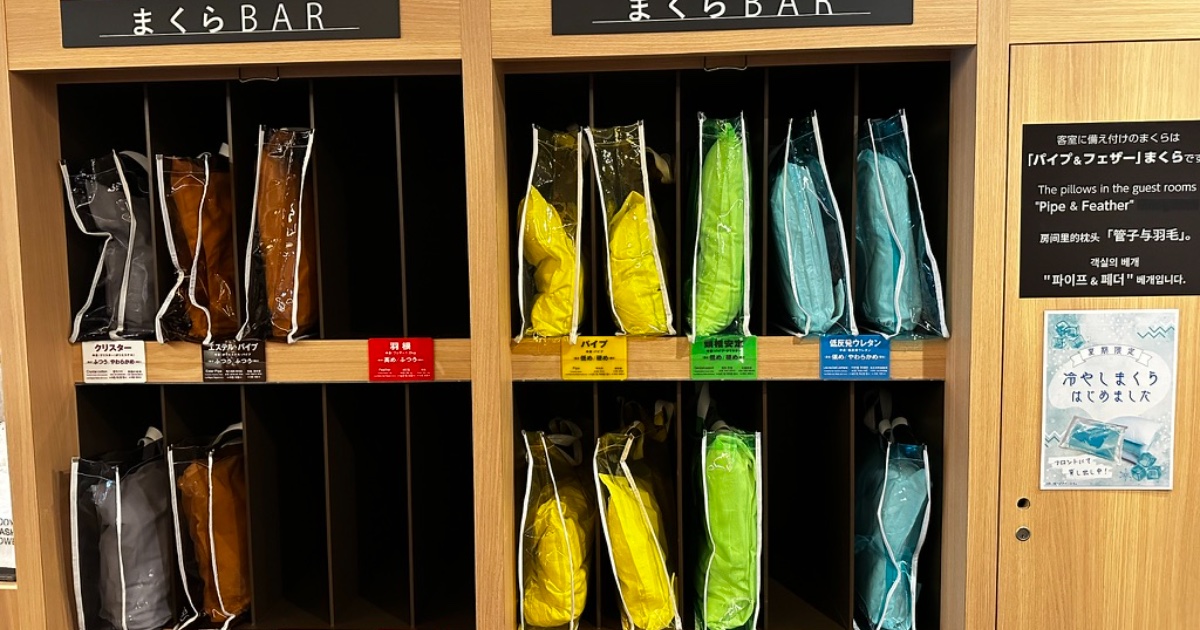
The same logic extends to things I would never have thought to ask for. One hotel had a pillow bar, an entire wall of pillows in different firmness levels and materials, free to borrow so you can find the one you actually sleep well on. That is the picture at the top of this post. I still think about it.
Sunscreen: deliberately did not bring it, bought it there instead. Japanese sunscreen is excellent and cheap, and in that heat I needed it daily anyway.
Two small hotel truths
First, the bathrooms in Japanese business hotels are tiny. They are moulded units, and they can feel a bit claustrophobic if you are used to space. The solution is easy and much nicer: if the hotel has a public bath, use that instead. More room, a proper shower, hot water to soak in afterwards. I did this in every hotel that had one, and it turned the smallest annoyance of the trip into one of my favourite routines.
Second, check-in times are strict. Fifteen o’clock means fifteen o’clock, and arriving at half past twelve does not help you. I got caught by this twice. The first time I sat in a café and felt slightly sorry for myself. The second time I left my bag at reception and went for a ninety minute foot and body massage at a walk-in place next to the hotel, which cost very little and was wonderful. That is the better solution, and those massage places are everywhere.
So how hard is Japan, really?
Less hard than I had built up in my head. The systems are consistent, the staff are helpful even across a language gap, and most things that could go wrong have a well-organised answer waiting.
If I had to compress it into four lines: send your suitcase ahead, get an IC card in your phone before you fly, check that your adapter actually has flat type A pins, and ask your hotel when something seems impossible.
Have you been to Japan, or are you planning to go? Is there a system you found confusing, or one you wish someone had told you about before you landed? I would love to hear.