
To be honest, I had never spent one minute of my life thinking about wigs. Then my doctor said the word “chemotherapy”, and suddenly wigs became a topic. Would I lose my hair? Yes. All of it? Pretty much. Should I get a wig then? Well, that one took me much longer to answer, and my answer will probably surprise you: I got a beautiful wig, almost for free, and I wore it five times in total. 😅
So, is a wig worth it? Let me tell you the whole story, and you can judge for yourself.
The system: how wig support works in Norway
Let me start with the practical part, because it’s genuinely good news. If you lose your hair because of cancer treatment, NAV gives you support for a wig. The current rates per calendar year: up to 6,265 kroner for a standard wig if you’re over 30, up to 16,220 kroner if you need a custom or real-hair wig because of allergy or head shape, and if you’re under 30, up to 50,000 kroner. If you’d rather use scarves and caps instead, you can get the same 6,265 kroner for those, but you have to choose, wig or headwear, not both in the same year.
And here is the part that still amazes me: I never talked to NAV at all. On my very first day at the hospital, they handed me a pile of practical information, including a list of wig shops with NAV agreements. If you go to one of those, the shop does all the paperwork and gets the money directly from NAV. You only pay whatever the wig costs above the support. If you buy from a shop outside the list, you pay everything yourself and apply to NAV for the refund afterwards. So: use the list, save yourself the bureaucracy.
One tip from a nurse that turned out to be important: book the wig appointment immediately, even if you still have all your hair. Good shops fill up, and the whole point is to get there while your hair is still on your head.
First, a confession: the Temu experiment
Before my first chemo, in the waiting weeks while I did egg freezing, I ordered two wigs from Temu. Very cheap. And they looked exactly as cheap as they were: shiny plastic party wigs. I tried them on once and gave them away. Lesson learned: with wigs, you really get what you pay for, and the cheap ones look cheap from very far away.
The wig shop
I picked a random shop from the hospital’s approved list and went there right after my first EC round, hair still intact. The visit works like this: they ask about your preferences, then bring some wigs to you. You try them on, they bring more if you want, lots of them, I went through maybe ten, and you choose model, color, style, and price. I picked a synthetic one as close to my natural hair as possible. Real hair, if you’re curious, starts around 20,000 kroner, far beyond both my budget and my support rate. Then they adjusted it to fit my head.
The second visit was around two weeks later, right before my second EC round. By then my hair had fallen out in earnest and I had shaved my head. They cut and styled the wig on me like a normal hairdresser appointment, and I paid and took it home.
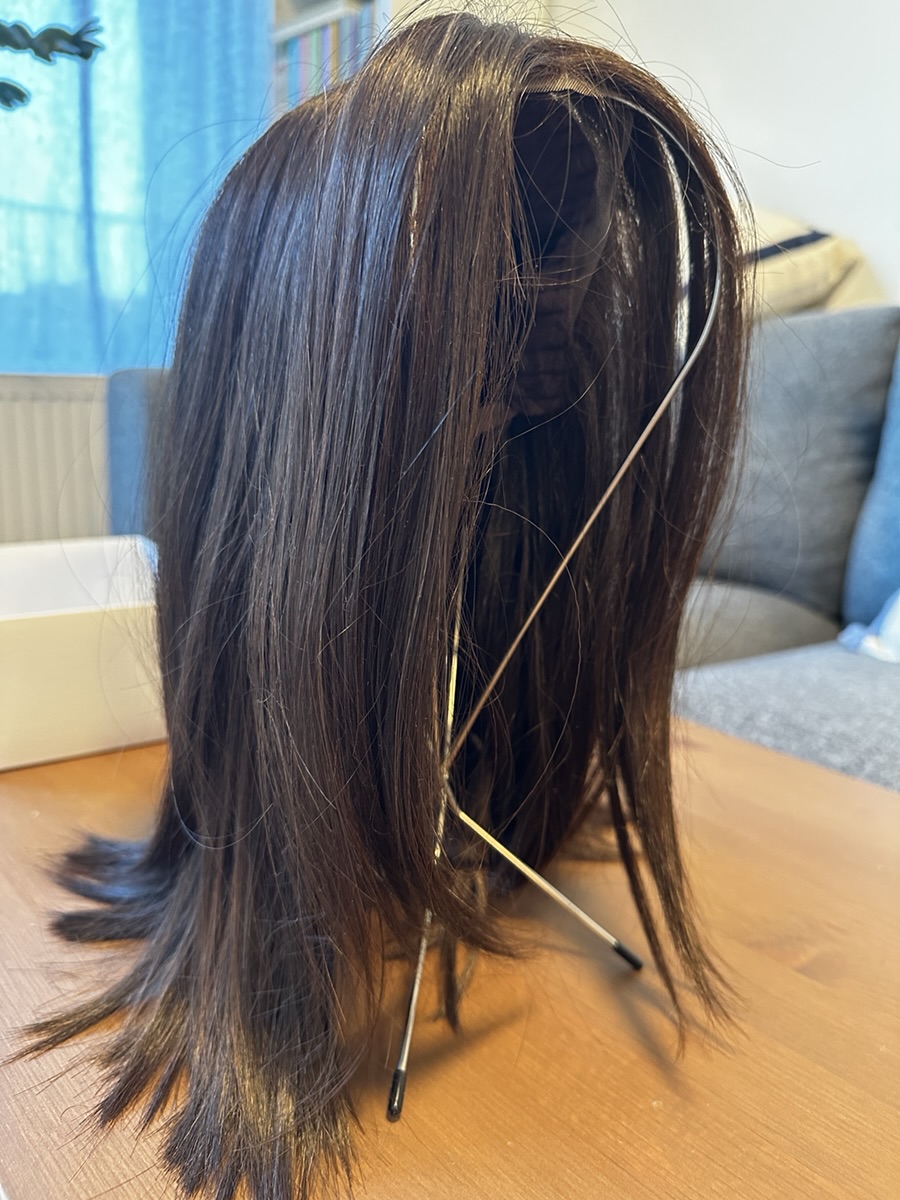
My bill: 1,235 kroner. That included the wig itself (real price around 7,500), a stand to keep it on, a comb, and special shampoo and conditioner, plus care instructions. The system worked exactly as promised: NAV’s part went directly from NAV to the shop, and I never saw a form.
Then I wore it five times
Including the day I wore it home from the shop.
It wasn’t the wig’s fault, exactly. It was a good wig, well fitted, professionally styled, color-matched. But my first chemo was in mid-May, summer was coming, and a wig is hot. Not itchy, just hot, plus a strange constant feeling of something tied onto my head, a low-grade headache that never let me forget it was there. I kept feeling it could blow away at any moment (the hairdresser promised it couldn’t, though she did mention my flat back of the head holds a wig less well than a rounder one, thanks for that new insecurity 😄). And here’s a small thing nobody tells you: when your real hair is too warm, you tie it up in a ponytail. You cannot ponytail a wig.
But the deepest problem was this: I didn’t feel like myself in it. I had chosen carefully, matched my old color and style, and it still looked fake on me. What I didn’t understand until too late is that the fake look doesn’t come from the hair, it comes from the hairline. When you have no hair at all, no baby hairs around the ears, no soft transition at the forehead, a wig’s edge is just visibly a wig’s edge. If I could choose again, I would pick one with bangs to cover the hairline. My rescue trick was a bucket hat on top of the wig, which hid the hairline and suddenly made the whole thing look real. But then I had to ask myself: if the wig only looks good with a hat on top, what is the wig actually doing? 🤔
What I actually wore
Scarves. Tied as a turban: quick, comfortable, cool, and honestly, I looked good in them. At home, bare head. And as the treatment went on, bare head outside too, partly because that summer was simply too hot, and partly because somewhere along the way I stopped caring what people thought about my head. The deeper you go into treatment, the more real things there are to think about, and “what do strangers think of my bare head” quietly fell off the list. I never felt ugly or embarrassed without hair. I got used to bald me surprisingly fast, faster than I expected, actually.
The wig, meanwhile, lived in its box. It still does. I keep thinking I should give it away, but it was fitted and cut for my head, so it wouldn’t sit right on someone else anyway. And yes, I feel a little guilty every time I see the box, 1,235 kroner divided by five outings is 247 kroner per wear, my most expensive accessory per use ever. 😅
So, is it worth it?
For me: no. But here’s the thing, because NAV covered most of it, finding that out cost me very little, and that changes the answer completely.
If you’re in Norway and facing chemo, my honest advice: get the wig. With the support, the price of being wrong is small, and the price of wanting one in November and not having it is bigger. But choose better than I did: think about the hairline, consider bangs, and try it with the headwear you actually plan to use.
And know this: whether a wig matters is really a question about you, not about wigs. Everyone has a different relationship with their hair. For some women, losing it is the hardest moment of the whole treatment, the moment cancer becomes visible to the world, and for them a good wig can mean everything. For me, shaving my head turned out to be… nothing, really. No drama, no tears. Neither reaction is wrong, and honestly, you won’t know which kind you are until you’re standing there. That is exactly why the nearly-free wig is worth having in the closet, even if, like mine, it mostly stays there.
Did you get a wig during treatment? Did you actually wear it, or did it live in a box like mine? I’d love to know I’m not the only one. 👇
Disclaimer: I’m not a doctor and I won’t give any medical advice. All I share is my personal experience based on my own treatment plan. NAV rates mentioned are the 2026 rates, check nav.no for current numbers.