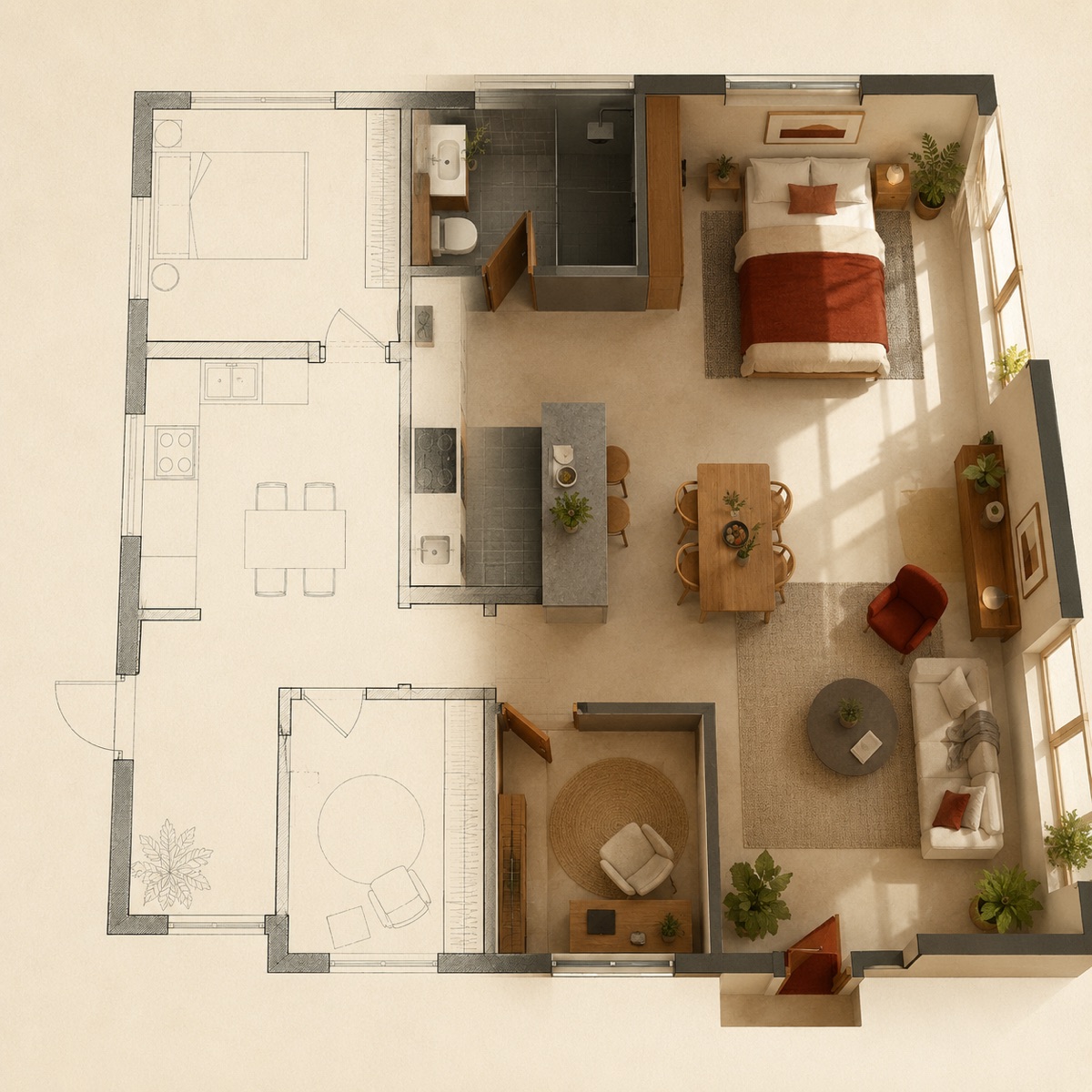
I just signed the contract for my third apartment in Norway. Three purchases in eight years, and I have never once stood in a bidding war, never renovated a bathroom, never opened a tilstandsrapport with my heart beating. Because all three were brand new.
This is not because I’m rich. Actually, it’s partly because I was not. Let me explain, because I think “buying new” is one of the most misunderstood options for us foreigners in Norway, and it deserves a proper story.
Three apartments in eight years
My first apartment was in a commuter town outside Oslo. I signed the contract in October 2018 for a 47 m² apartment that did not exist yet. There was nothing to see, just drawings and a price list: 2.79 million kroner including a parking spot. I got the keys in June 2021, almost three years later. And no, that was not a delay, that is completely normal here. You sign, they build, you wait.
Here is the funny part: I lived there for two months. Two! I worked in Oslo center, and let’s be honest, a commuter town is not Oslo. A good friend of mine had just bought a new apartment in Oslo as an investment, so I moved in as her tenant, and rented out my own place. (Being a landlord in Norway is a whole story of its own, I will write about it another time.)
Then in 2024, cancer came into my life, and it changed my housing plans too. I knew I would not move back there, so I sold it. With that money, in early 2025, I bought apartment number two: a 45 m² flat in a newly finished building in Oslo. It was not even the apartment I wanted. I had aimed at the 52 m² one, the only one left that I could afford, but when I contacted the seller, it had been sold just hours before. So I took the 45 m² right next to it, with the help of a special first-time-buyer-friendly scheme (that one deserves its own post too, coming soon).
And now, number three: a 59 m² apartment with a real second bedroom and a parking spot in the basement, in a new development just outside Oslo. I found it one lazy afternoon when I had nothing to do and was just browsing. Isn’t that always how the big decisions start? 😄
Why I keep choosing brand new
1. I’m scared of oppussing. I have been to many visninger of older apartments. Everyone else sees “charming, with potential”. I see a bathroom from 1994 and a renovation project that will eat my savings and my evenings. With a new apartment, everything is untouched. The first shower in that bathroom is mine.
2. No bidding war. When I bought in 2018, the market was crazy. Prices ran away every month, apartments went far over takst, and the bidding rounds were honestly painful to watch. New builds work differently: there is a price list, the price is fixed, first come first served. You never stand there at 11 in the morning, sweating, while someone outbids you by 50,000 kroner every five minutes.
3. The secret nobody talks about: the waiting time is a savings plan. This is the biggest one, and I almost never see it explained. When I signed in 2018, I paid only a small deposit. The rest? Not due until takeover, three years later. I didn’t actually have enough equity for the bank at signing time, a dear friend helped me bridge the gap for the paperwork at the very start, and I paid her back right away. Then I had three whole years to save up the real thing, while my salary also grew. In practice, I reserved a 2021 apartment at a 2018 price, and used the construction time to become the person who could afford it. If I had needed all the money on day one, there would be no apartment.
4. The boring but real money details. When you buy a used home in Norway, you pay 2.5% dokumentavgift on the whole price. On a new build, you pay it only on the land value. For my first apartment, the total purchase costs were under 13,000 kroner. On a similar used apartment, it would have been more like 65,000. And new builds come with a five-year guarantee from the builder, so if something is wrong, it is their problem, not mine.
The honest downsides
I promised you honesty, so here it is.
You pay a premium. New costs more per square meter than used, that is just true. I accept it as the price of no oppussing and no bidding stress.
You might wait years. Three years, in my case. And there is a detail many people miss: when a project opens for sale, the developer usually needs to sell a certain share of the apartments before they are allowed to start building at all. In my first project it was 33%. If they don’t reach it, the project can be cancelled and you get your deposit back. So you are not just waiting for a building, you are first waiting to find out if there will even be a building.
You might buy blind. My first apartment I bought purely from drawings, and I am honestly bad at imagining rooms from a floor plan. It was a blind buy. I was lucky: when I finally stood in it, it was bigger than I had imagined, with a really good layout. My second one also positively surprised me. But I know it could have gone the other way.
The tilvalg trade-off. If you buy early, you can choose finishes and upgrades, called tilvalg. If you buy late or finished, those deadlines have expired and you get the standard delivery. Personally I don’t care, I have bad taste in art anyway, I just prefer white. Standard Norwegian delivery is completely fine to live with. But if you dream of your own kitchen colors, buy early.
Drawings or finished? The market decides for you
Here is something I only understood after three purchases across very different markets: you don’t really choose between buying from drawings and buying finished. The market chooses for you.
In hot years, like 2018, projects sell out on paper long before anyone starts digging. Everyone buys blind, because that is the only option. In slower years, like now, some apartments are still available after the building is finished, so you can walk through the actual rooms before signing. That is a much calmer feeling, I can tell you.
A slow market has another quiet advantage: developers become flexible. In my current purchase, the deposit requirement kept shrinking as the sales went slowly, until it basically disappeared. I’m not saying this is universal, it is not, but it shows that in a soft market, the terms are not as fixed as the price list looks.
My advice, for what it’s worth
If you are a foreigner in Norway dreaming about your own place: try to buy as soon as you realistically can. The rental market here is not like in many other countries, it is small and expensive, and renting long-term is rarely a good deal. Buying is paying to yourself. Renting is money you will never see again.
And your first apartment does not need to be the dream apartment in the dream location. Mine was 47 m² in a commuter town I left after two months. It was still the best financial decision I ever made, because it got me onto the ladder. Everything after that was just climbing.
This is part 1 of a little series about buying a home in Norway. Next up: what my 5.4 million kroner apartment actually costs, all the numbers nobody shows you. And someday soon, the story of how a foreigner saves up for that very first egenkapital.
So, tell me: would you dare to buy an apartment you have never seen, from a drawing? Or have you already done it? I would love to hear how it went. 👇
Disclaimer: I’m not a financial advisor and this is not financial advice. Everything I share is my personal experience from my own three purchases, and your situation may look completely different.